
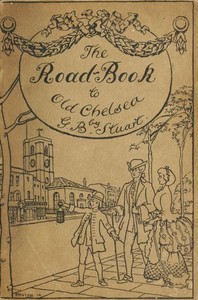
A road-book to old Chelsea by G. B. Stuart
Published in 1907, A Road-Book to Old Chelsea is exactly what the title promises: a guide. But it's a guide from another time, written by Grace Benedicta Stuart, a woman who clearly knew and loved every cobblestone. She doesn't just list buildings; she tells you who lived there, what they did, and the scandals or triumphs that happened behind those doors. The book is structured as a series of walks, each one peeling back a century or two as you move from the Thames embankment into the heart of the old village.
The Story
There isn't a fictional plot, but there is a clear narrative drive: the journey itself. Stuart starts you at Chelsea Old Church and sends you on a loop, down Cheyne Walk, past the sites of great mansions and humble almshouses. She points out where the Tudor kings partied, where the painter Whistler had his studio, and where the botanist Sir Hans Sloane cultivated his garden. The 'story' is the accumulation of these lives and events in one small patch of London. It's about the physical marks they left—a carved doorway, an ancient tree, a forgotten street name—and how they all add up to create the unique character of a place. Stuart is constantly comparing what she sees in 1907 with historical records and paintings, noting what's changed and what's miraculously survived.
Why You Should Read It
I loved this book because it makes history personal and immediate. Stuart writes with such affection and specificity. You get the sense she's worried these stories will be lost to new construction and changing times (which, from our viewpoint over 100 years later, is deeply poignant). She introduces you to people, not just monuments. You learn about the fiery preacher at the church, the eccentric collectors, and the tragic poets. It turns a neighborhood into a community you feel you know. Reading it with a map of modern Chelsea (or Google Street View) is a fantastic experience—you can see how much is utterly different, and sometimes, spot the one old building that's still stubbornly standing.
Final Verdict
This is a perfect book for anyone with a soft spot for London, social history, or urban exploration. It's for the reader who enjoys biographies, but of a place rather than a person. If you liked books like London Labour and the London Poor or the works of Peter Ackroyd for their deep-dive atmosphere, you'll appreciate Stuart's ground-level, street-by-street approach. It's also a fascinating read for writers or artists looking to understand how a location can be saturated with stories. A word of warning: it's a product of its time, so some references and attitudes are dated. But as a passionate, detailed, and wonderfully human snapshot of a neighborhood's soul, captured just before the modern world rushed in, it's completely captivating.
This book is widely considered to be in the public domain. It serves as a testament to our shared literary heritage.
Jennifer Nguyen
7 months agoVery helpful, thanks.
Kenneth Smith
2 years agoJust what I was looking for.
Patricia Hill
1 year agoSolid story.
Ava Moore
1 year agoNot bad at all.






Michael Hernandez
1 year agoI have to admit, the character development leaves a lasting impact. Truly inspiring.