
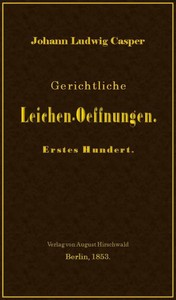
Gerichtliche Leichen-Oeffnungen. Erstes Hundert. by Johann Ludwig Casper
Let's be clear from the start: this is not a novel. 'Gerichtliche Leichen-Oeffnungen. Erstes Hundert' is a meticulously compiled forensic record. Published in 1854, it collects one hundred autopsy reports conducted by Dr. Johann Ludwig Casper for the Berlin courts. But within those clinical details lies a compelling narrative of a scientific revolution hitting the gritty reality of crime.
The Story
The 'story' here is the birth of forensic pathology. Each chapter is a case file. A body is found under suspicious circumstances—maybe floating in a canal, discovered in a home, or recovered after a violent argument. The local authorities have theories, but Casper is called in to find the physical evidence. He systematically examines the corpse, describing injuries, organ conditions, and chemical tests for poisons like arsenic. His goal is to move past rumor and guesswork. Was a wound inflicted before or after death? Could this internal damage have been caused by a fall, or by a blow? His findings often overturned initial assumptions, proving murders were accidents, or revealing foul play where none was suspected.
Why You Should Read It
What makes this book fascinating is Casper's voice. He's not a detached scientist; he's a crusader for objective truth in a messy world. You can feel his frustration with sloppy investigations and his determination to let the body 'speak.' Reading it, you become a detective alongside him, learning to interpret the clues he painstakingly documents. It’s also a startling window into 19th-century life—the common poisons, the domestic violence, the industrial accidents. The human drama behind each case is palpable, even as Casper focuses on the physical facts. It’s a powerful reminder of how this science, which we now take for granted, started with someone methodically opening a hundred bodies to ask 'how?' and 'why?'
Final Verdict
This book is a niche treasure. It's perfect for true crime enthusiasts who want to go beyond the podcast and see the foundational documents of the genre. It's also great for history of science buffs or anyone interested in medicine's past. Be warned: the descriptions are clinically graphic. But if you can handle that, you'll find a uniquely gripping and insightful record. It’s not a light read, but for the right reader, it’s an absolutely captivating one.
This digital edition is based on a public domain text. Preserving history for future generations.
Donald Walker
1 year agoFrom the very first page, it manages to explain difficult concepts in plain English. One of the best books I've read this year.
David Johnson
7 months agoAfter finishing this book, the plot twists are genuinely surprising. A valuable addition to my collection.
Michelle Gonzalez
5 months agoThis book was worth my time since the narrative structure is incredibly compelling. A valuable addition to my collection.
Elijah Miller
8 months agoSurprisingly enough, it challenges the reader's perspective in an intellectual way. A valuable addition to my collection.

Daniel Davis
2 years agoI have to admit, the pacing is just right, keeping you engaged. A true masterpiece.