
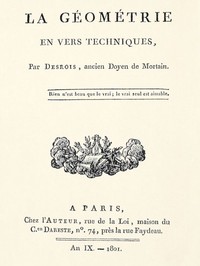
La géométrie en vers techniques by Lyon Des Roys
Let's be clear from the start: this is one of the most unusual books I've ever come across. La géométrie en vers techniques is exactly what its title promises—a geometry textbook written entirely in technical verse. Published in the 19th century by Lyon Des Roys, it presents geometric principles and proofs not in plain prose or simple diagrams, but through structured, rhyming poetry.
The Story
There isn't a plot in the traditional sense. The 'story' is the book's own existence. Each page is a new proposition or theorem, meticulously crafted into rhyme. You'll find verses explaining the properties of triangles, the calculation of areas, and the relationships between angles, all with a strict meter and rhyme scheme. Reading it feels like uncovering a secret project. You follow the logical steps of a geometric proof, but the rhythm of the words adds a completely different layer to the process. It's a slow, deliberate unraveling of a very peculiar intellectual feat.
Why You Should Read It
You should read this because it's a beautiful artifact of human obsession and creativity. It makes you wonder about the person behind it. Lyon Des Roys wasn't just a mathematician; he was a poet of precision. The constraint of the verse form forces an incredible clarity and elegance. It’s surprisingly effective as a learning tool—the rhymes make the concepts sticky. But more than that, it’s a glimpse into a time when knowledge could be pursued as an art form. The book has a quiet, confident charm. It doesn't shout; it patiently waits for a reader willing to engage with its unique rhythm.
Final Verdict
This book is perfect for curious minds who enjoy historical oddities, lovers of rare books, and anyone with an appreciation for where science and art intersect. It’s not for someone looking for a fast-paced narrative. But if you're willing to slow down and appreciate a singular, almost meditative work of intellectual passion, you'll find something special here. Think of it as a literary cabinet of curiosities—small, precise, and utterly memorable.
This digital edition is based on a public domain text. You are welcome to share this with anyone.
David Young
6 months agoI stumbled upon this title and the character development leaves a lasting impact. Absolutely essential reading.
Karen Scott
1 year agoFinally a version with clear text and no errors.
Anthony Martinez
2 years agoThe formatting on this digital edition is flawless.
Anthony Wilson
1 year agoBeautifully written.
Brian Davis
2 years agoVery interesting perspective.