
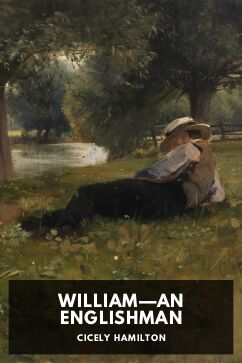
William—An Englishman - Cicely Hamilton
I picked up Cicely Hamilton's William—An Englishman knowing almost nothing about it, and I'm so glad I did. Published in 1919, it reads with a startling immediacy, like a letter from the heart of a catastrophe.
The Story
We meet William, a clerk whose life revolves around tame socialist meetings where revolution is debated over tea. He marries Griselda, a fellow believer in progress and reason. They are, in their own minds, modern and enlightened. To celebrate, they take a hiking honeymoon in a remote part of Belgium, completely insulated from the growing political tensions. Their idyll is shattered when Germany invades. Suddenly, their abstract political arguments mean nothing. They are refugees, then prisoners, witnessing atrocities they never dreamed possible. The story follows their desperate struggle to survive, not just physically, but as the people they once were. The war systematically dismantles every belief, every comfort, and every ounce of innocence they possessed.
Why You Should Read It
Hamilton, who worked in field hospitals during the war, writes with a cool, almost surgical precision that makes the horror even more potent. She's not interested in heroics. She's interested in the collapse of a worldview. Watching William and Griselda's polite certainties get steamrolled by history is heartbreaking. You see how their love is strained and changed by trauma. The book is a fierce indictment of the blind patriotism and naive idealism that Hamilton saw as paving the way to the slaughter. It's also surprisingly psychological, getting deep inside the shock and dissociation of its characters. It feels less like a period piece and more like a timeless study of human fragility.
Final Verdict
This book is perfect for readers who appreciate character-driven historical fiction that pulls no punches. If you loved the intimate despair of Pat Barker's Regeneration trilogy or the civilian perspective in Helen Dunmore's The Siege, you'll find a kindred spirit here. It's also a must-read for anyone interested in early 20th-century literature by women—it won the first-ever Femina Vie Heureuse Prize for its raw power. Be warned: it's not a cheerful read. But it's a profoundly moving, intelligent, and unforgettable one that deserves its place back in the spotlight.
No rights are reserved for this publication. It serves as a testament to our shared literary heritage.
Donna White
5 months agoWithout a doubt, it challenges the reader's perspective in an intellectual way. A valuable addition to my collection.
Emily Robinson
1 year agoAfter hearing about this author multiple times, it manages to explain difficult concepts in plain English. Exactly what I needed.
John Anderson
1 year agoNot bad at all.
Nancy Williams
1 year agoComprehensive and well-researched.


Barbara Torres
5 months agoThanks for the recommendation.